Mad Men, Marketforce style: When Marketforce ruled Perth Advertising
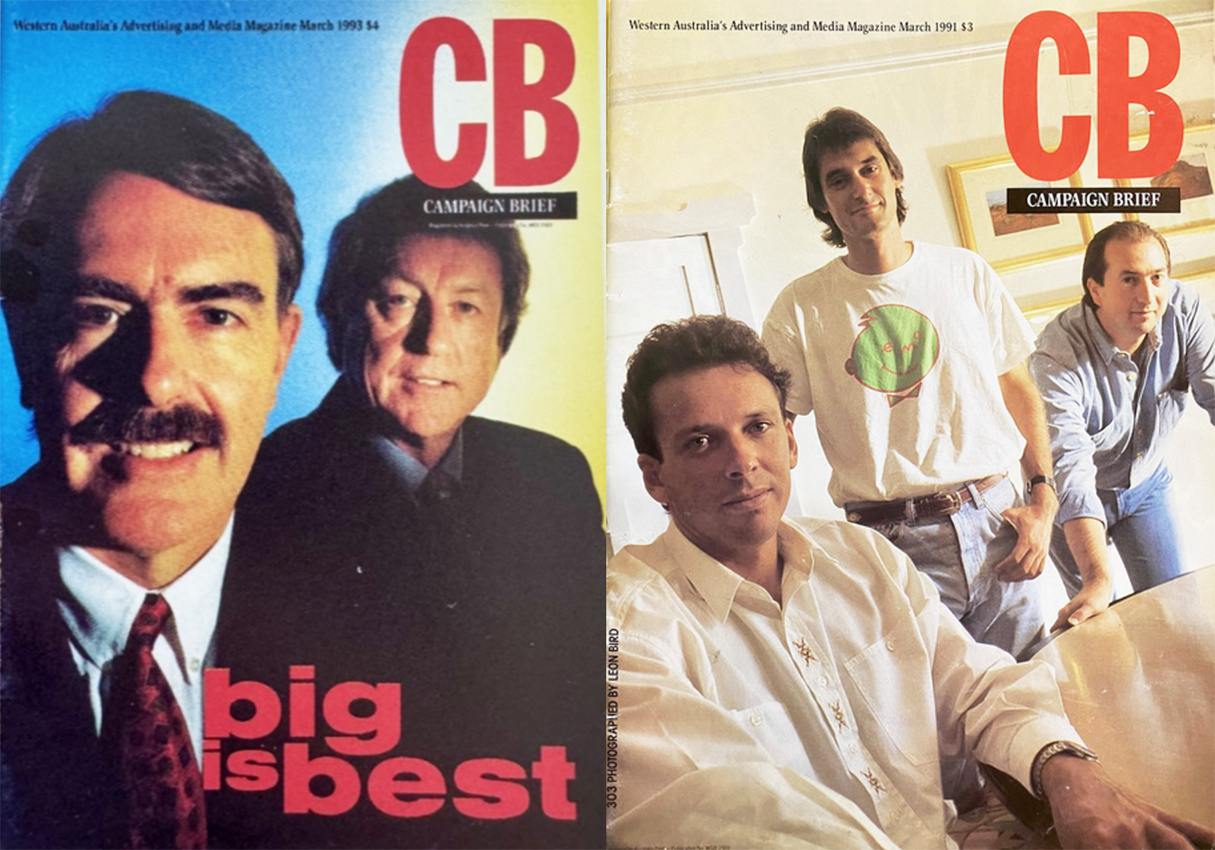
With Marketforce closing its Perth doors this month, one of the most significant chapters in the history of Western Australian advertising has come to an end. At its peak, Marketforce was far more than an advertising agency. It was a powerhouse of Perth business and culture, with billings of more than $100 million, a staff of around 140 and a client roster that included some of the biggest brands and organisations in WA. For decades, it attracted some of the market’s best creative, media and account talent and played a defining role in shaping the Perth advertising industry. Few people are better placed to recall what Marketforce was really like in its heyday than Stephen Wells. Wells joined the agency in 1985, initially as Media Director, despite having never previously worked in advertising, media planning or buying. He went on to become one of the key figures in the agency’s history before leaving in 1990 with Lindsay Medalia and Ray Van Kempen to establish 303, another agency that would go on to leave its own substantial mark on Perth advertising. What follows is Stephen’s personal account of Marketforce between 1985 and 1990 – the people, the clients, the characters, the work, the parties, the extraordinary stories and ultimately the events that led to the creation of 303. Told with humour, affection and the benefit of hindsight, it offers a first-hand glimpse inside the agency at the height of its influence.
The hook
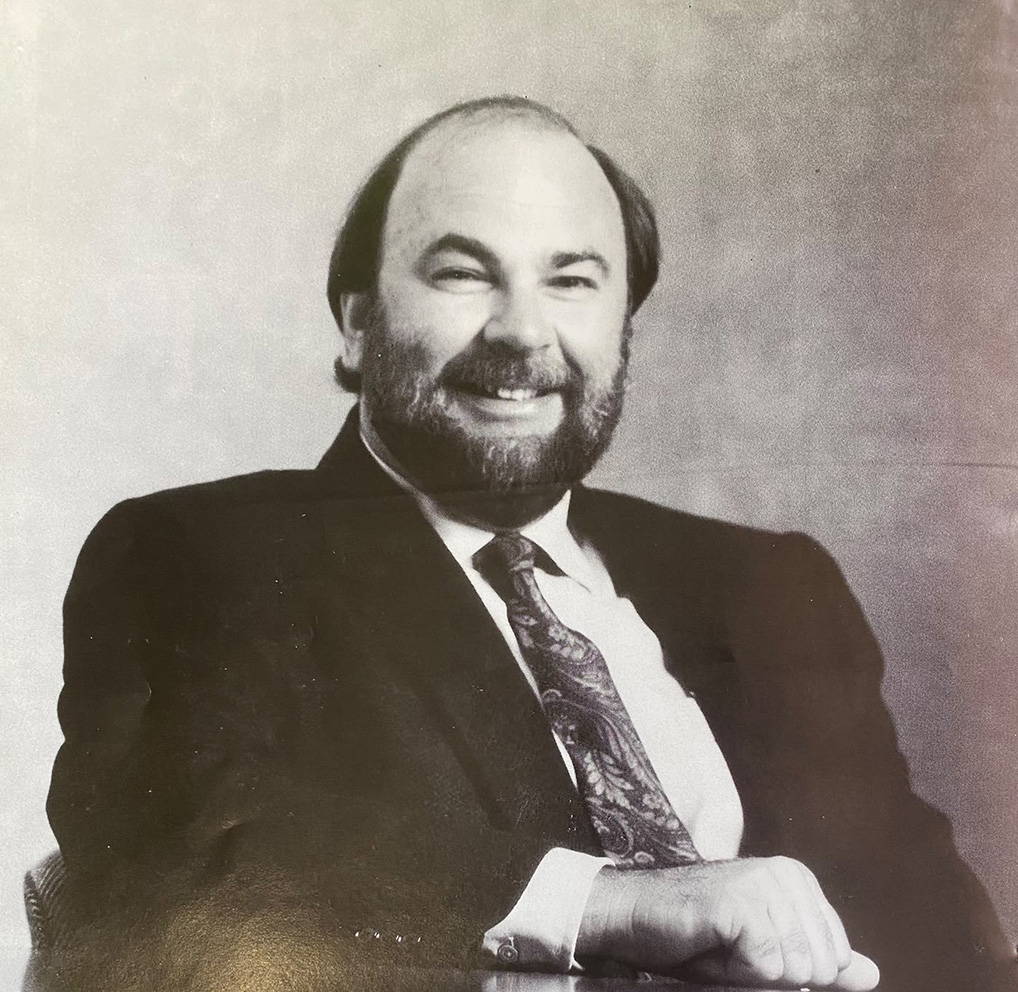
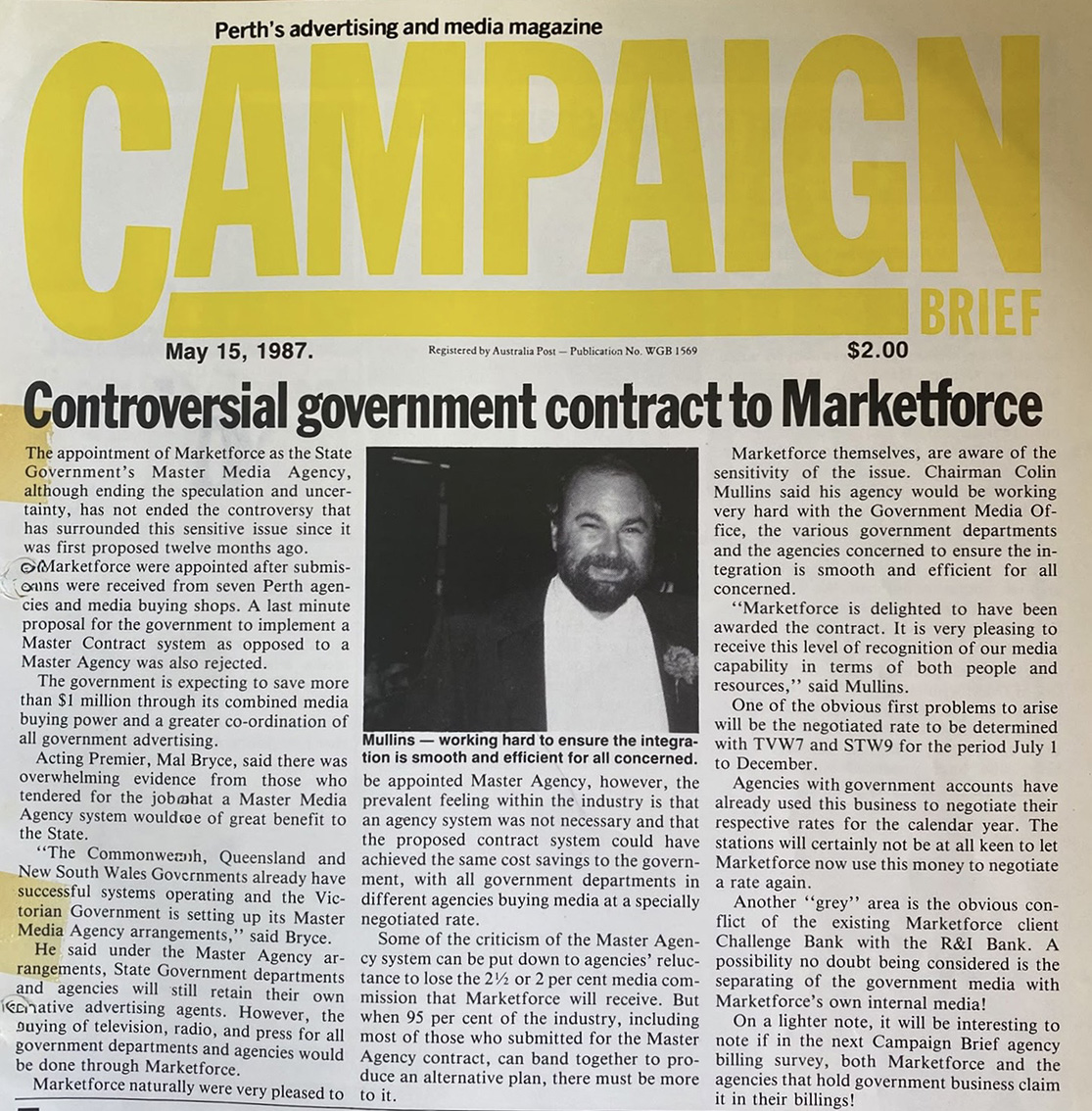
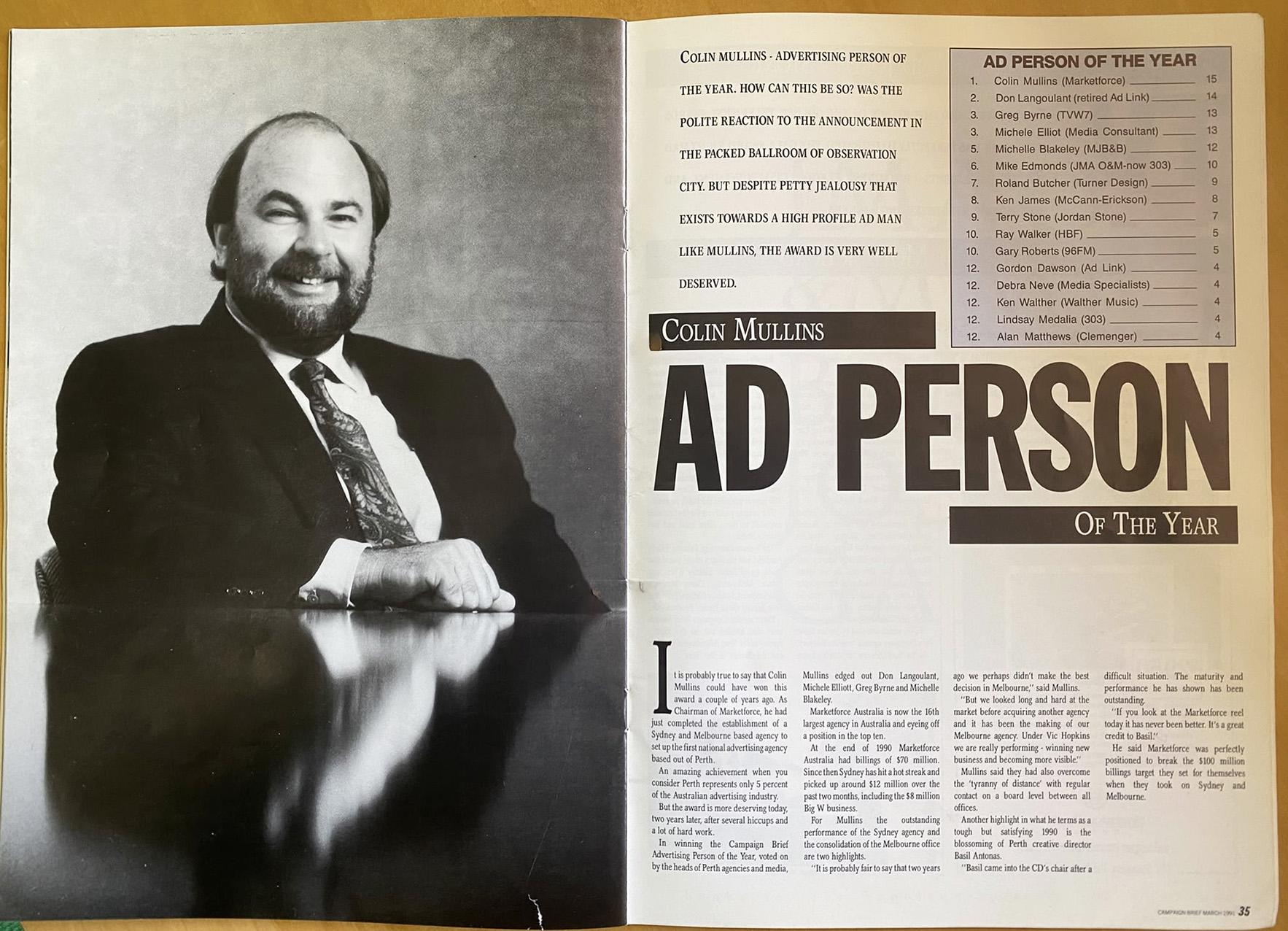
Every great advertising story starts with a proposition. Or at least a seduction dressed up as opportunity. Mine started in 1985 when Colin Mullins (pictured above), Chairman of Marketforce and undisputed emperor of the Western Australian advertising fiefdom, decided he wanted me.
I was working at Channel 9 under David Aspinall, minding my own business. Colin didn’t phone. Someone else did. Then Colin appeared with the kind of gregarious, slightly intimidating charisma that makes you feel simultaneously flattered and outmanoeuvred. He wanted me to replace Terry Gabeddy as Marketforce’s Media Director. The only detail he glossed over was that I had never worked in advertising, media planning or media buying in my life.
I took the job anyway with a mix of trepidation and excitement. This tells you everything you need to know about Colin Mullins, and probably about me.
If Mad Men’s Sterling Cooper agency had been transplanted to Perth in the late eighties, with scotch replaced by Swan Gold and Emu Export, Manhattan replaced by West Perth, and Don Draper operating in a town where everyone knew everyone and Alan Bond, having just won the America’s Cup, was buying anything not bolted to the floor, it would have looked a great deal like Marketforce.
Colin, and Marketforce, held court over the WA advertising market the way that monarchs hold court, with confidence bordering on arrogance, occasional ruthlessness, and the unspoken understanding that the natural order of things had been settled and resistance was futile.
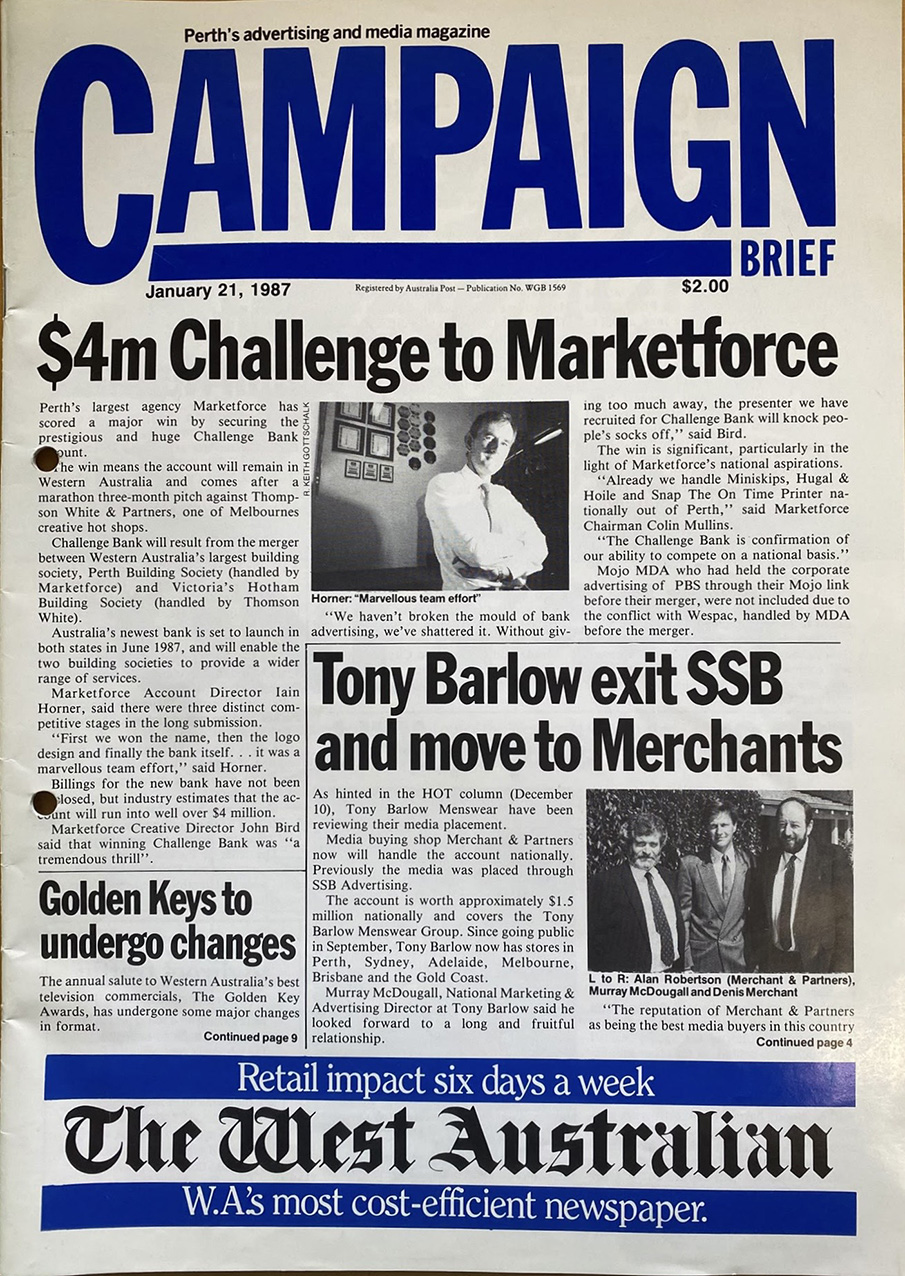
The client list told the story. Swan Brewery. WA Lotteries. (later) JeansWest. Brian Gardner Motors. Hungry Jacks/KFC. SGIO. Coca-Cola Amatil. Channel 9. The West Australian. Peters Ice Cream. Bond Corp. The Royal Perth Yacht Club’s America’s Cup defence campaign. Colin hadn’t built a client list. He had built an empire.
The cast
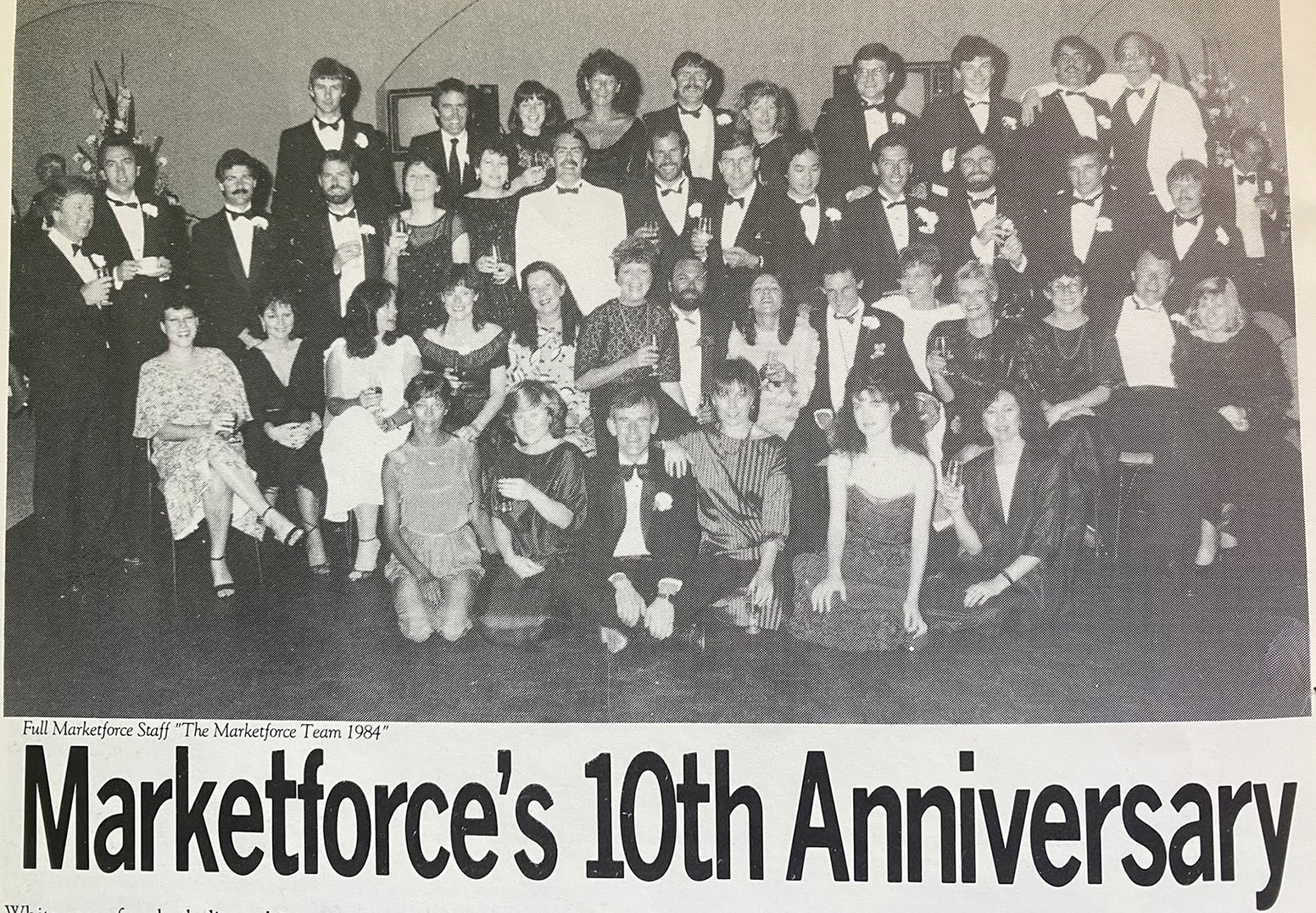
Every ensemble needs its characters, and Marketforce had them in abundance.
Colin Mullins was Roger Sterling and Bert Cooper rolled into one. Part showman, part patriarch, entirely himself. He ran Marketforce as though personal ownership were a technicality the shareholders hadn’t quite grasped yet. He was mates with Alan Bond, Laurie Connell, John Roberts, Dallas Dempster, in fact the full cast of WA Inc. He could get a meeting anywhere with anyone through sheer gravitas and bravado and then charm the room into submission once he’d talked his way through the door into the pitch. Business, booze and bling. That was the operating model, and for most of the eighties it was extraordinarily effective.
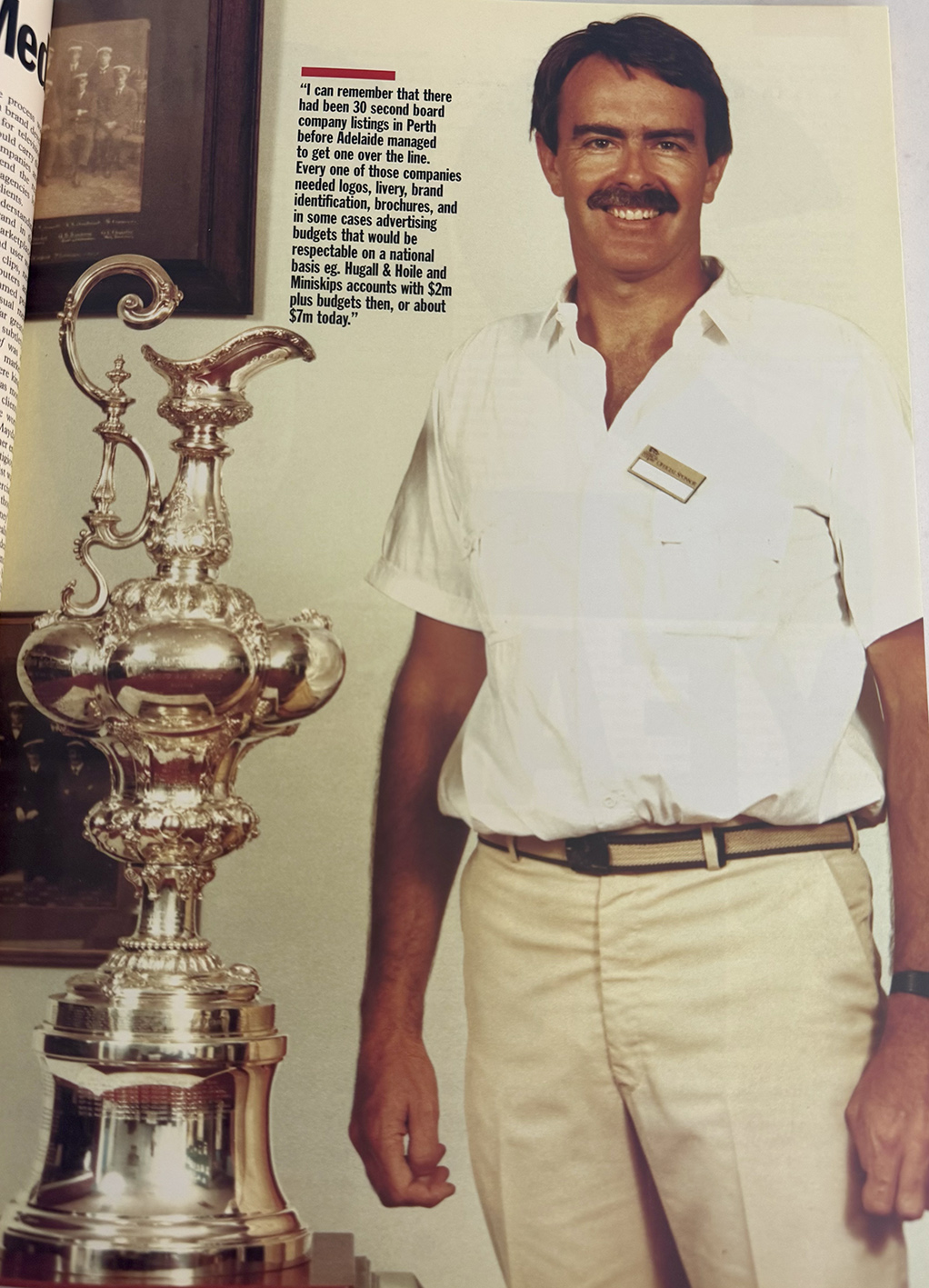
Howard Read (pictured below with the America’s Cup) was a hybrid, outwardly our Roger Stirling but probably more Ken Cosgrove. Howard was Colin’s reliable lieutenant who helped hold the operation together while Colin was either conquering new territory or somewhere he shouldn’t have been. Ex-Bond Corp, impeccably connected, never flustered. If there was a sniff of a new client, Howard was already making the call and organising the internal new business hit team.
Ian Horner, universally known as Horny, was Marketforce’s Layne Price. English, quirky, brilliant advertising strategist, masterful presenter, possessor of a God-given ability to make every client feel like the most important person in the room. Travelling with Horny was an experience that required stamina, a flexible approach to schedules, and the quiet acceptance that he might simply disappear at some point and resurface with no satisfactory explanation. In the end he did exactly that, for some mysterious reason, within a week he sold his shares, boarded a flight, and was never seen in Perth again. Even by Mad Men standards, that was a memorable exit.
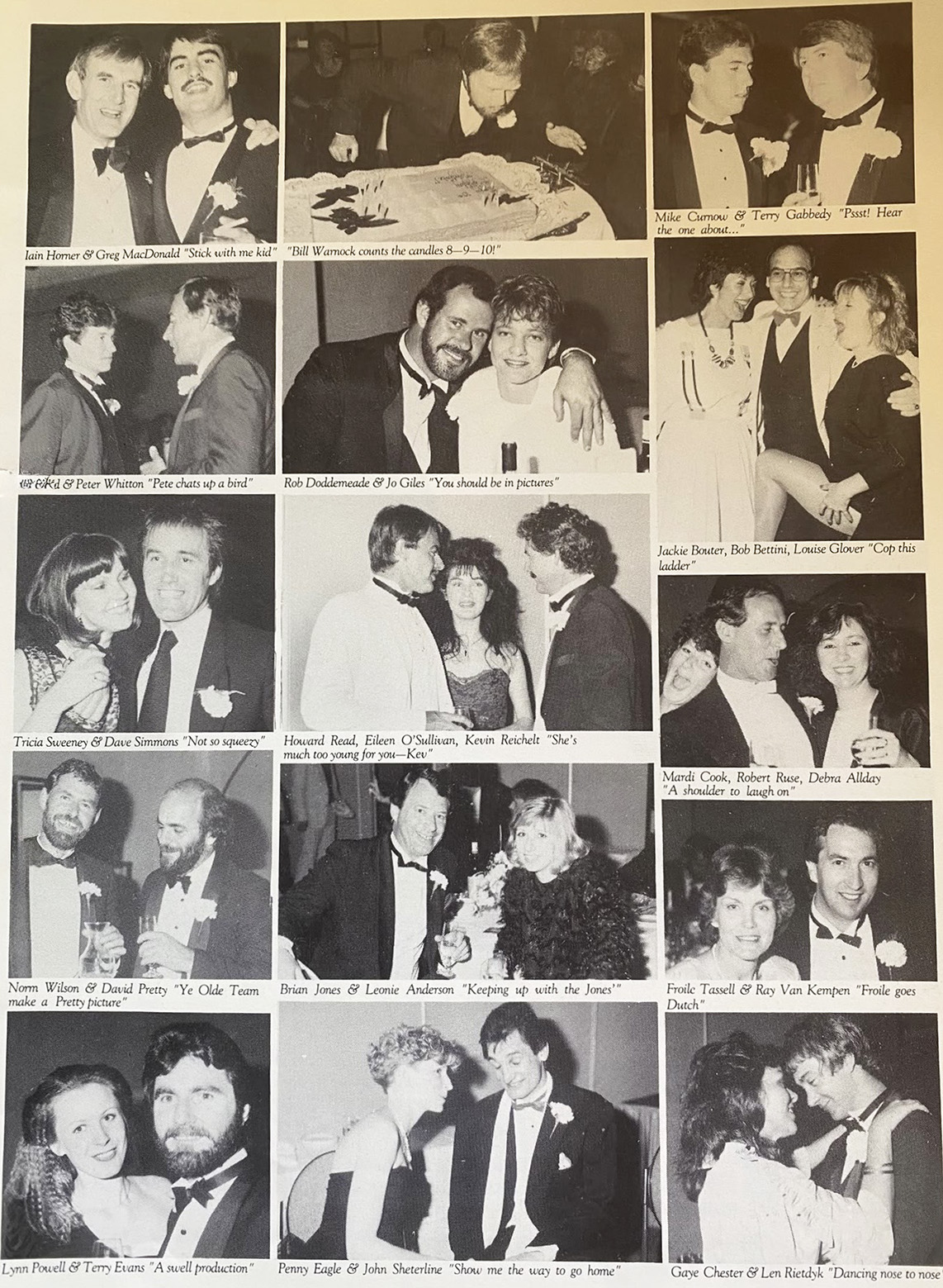
Ian Tassell (Tass) our General Manager was something of a Duck Phillips. Tass was a man with a marketing brain of unusual quality and the thankless task of keeping an agency full of brilliant, combustible people pointed in roughly the same direction. He worked alongside Louise (Glover) and Trish (Sweeney) on accounts his accounts, subsequently married Trish, and eventually bought a winery in Margaret River, which is perhaps the most satisfying and appropriate outcome achieved from that era.
Terry Gabeddy, was Harry Crane (just add 25 years) and the media genius I was brought in to replace and who had the grace to teach me everything I needed to know, was the agency’s resident showman, literally. He would arrive at staff parties in a kaftan. His grasp of reach and frequency was matched only by his sense of theatre, and both were considerable.
Lindsay Medalia, who rose to Creative Director, was a cross between Ginsberg and Don Draper. He brought the creative depth and conceptual rigour that helped make the expanse of Marketforce’s creative work stunningly good.
Jon Bird, mentored by Colin, was to me Ginsberg, prolific, innovative competitive, the emerging super talent. Then there was the junior creative pool, a ragtag collection of individuals the HR profession of today would regard with a mixture of admiration and alarm. In fact they would likely have been fired many times over.
Jon Sheterline and Tom Martin formed the nucleus of what might charitably be called the agency’s creative insurgency. Funny, mischievous (naughty), and dishevelled (loose), with Malcolm Maclean and Ronny Samuel later adding to the ensemble.
Ray Van Kempen was a type of Sal Romano. An extraordinary art director aesthete who could produce a brilliant creative solution under impossible pressure and make it look effortless. He would matter enormously to what came later.
Norm Wilson was the quiet, talented artist who invariably saved the day when the client situation reached crisis point and only something genuinely beautiful would do.
Andrew Marcus was and always will be the quintessential Pete Campbell, young, slightly awkward, funny, resilient, apparently indestructible. At more than one board meeting where the subject turned to staff reductions, Andrew’s name would come up, but he would sneak through. Every time, Tass said the same thing: “Marcus is going to outlast us all!” He was right. I’d be confident Andrew is still in advertising.
Marketforce had something Mad Men didn’t. Jamie Dodd. A likeable, precocious and entrepreneurial 18-year-old courier who owned a Mercedes.
And there was Annie at reception, who could locate any human being in the building at any moment of the day, including one creative who had strategically retired to a quiet cupboard for horizontal research. Yes, it happened.
Lisa Maclean was our Joan. Just emerging at Marketforce but as 303’s very first employee, did everything and became general manager. Rapier-like insight, wit and cut through delivery. Red hair to match and intimidatingly organised.
Working at Marketforce (and the chaos around it)
The work was, by any measure, prolific and genuinely good. But the stories around the work were better.
When Alan Bond bought Swan Brewery, already a Marketforce account, he brought in Ian Creighton from over east, a marketing genius, a man of such operationally intense disposition that the agency quietly christened him “Crisis” Creighton.
One of our outstanding branding ideas for the launch of Swan Black to ride the America’s cup defence required painting the slick new Rottnest ferry entirely black so it could motor past Bond’s house on the river each day as a floating advertisement but mainly so his family could see it. Within two months, the summer heat had made the black hull so searingly hot it was destroying the boat’s structure. The ferry was quietly repainted. No one mentioned this to the client, or the cost.
The $100,000 outdoor campaign developed for Swan Brewery, a colossal sum in 1987 was approved through the agency, placed in media, and then pulled at the last minute by Crisis. The media, naturally, wouldn’t cancel. Colin, rather than absorbing a catastrophic loss, was on the phone to WA Lotteries within minutes. He presented the entire outdoor schedule as a unique, unrepeatable, exclusive premium opportunity. Lotteries took it on the spot. The problem became a triumph. This was Colin operating at the height of his powers.
There was the Lotto campaign pitch where Lindsay produced a brilliant television commercial of genuine quality depicting a surfer dude who had moved to Broome because had won Lotto and chosen to live simply and freely. The client pulled it. The surfer’s lifestyle, they felt, sent the wrong message about aspiration. Lindsay was philosophical. The creative industry is littered with brilliant work that clients found just that little bit too…true!
Colin’s plan to float Marketforce was derailed by the 1987 stock market crash, which had the poor timing to arrive while Colin was in a hot air balloon over the Serengeti on one of his YPO expeditions. Howard and the board were attempting to reach him with some urgency. There were no mobile phones. Colin floated serenely above the African plains while the plan to float Marketforce dissolved below him. He landed to find the world was suddenly a very different place.
My office, perched directly above Annie at reception, gave me an unobstructed view of the comings and goings at the front desk. The junior creatives discovered that when Ray or Norm were casting models for a shoot, the best intelligence source in the building was me. I would receive their request, buzz them Code Red, and they would descend the stairs in a group and conduct an extended, entirely fictitious business meeting in my office while forming their own views on the talent assembled below. This arrangement suited everyone and continued for some time.
The Christmas parties deserve their own documentary. There was the legendary Aga Khan’s restaurant gathering in Fremantle, and the America’s Cup Ball, and the party at Colin’s house in City Beach that continued well past any reasonable hour. Late in the evening, one of the junior account coordinators lost her footing and went into the pool, struck her head, and was retrieved from the water by a colleague who executed the rescue without putting down his glass of wine. She was fine. The party and Marketforce continued unabated.
The pilot strike, the Sebel bar, and the beginning of the end
In 1989, Lindsay and I flew to Sydney to shoot a JeansWest commercial. Then the pilots went on strike, and Australia’s domestic aviation system collapsed, and we were marooned at the Sebel Townhouse for ten days with nowhere to go and a very well-stocked bar.
It was in that bar, over the course of several extended evenings, that Lindsay and I concluded we were done with Marketforce. Not because it wasn’t extraordinary. It was. But the culture that had made it extraordinary, hierarchical, siloed, creative separated from clients by account management as a permanent buffer layer, lunch as a commercial weapon, margin extracted from every client breath had its own internal logic, but in my naive opinion that logic belonged to an era past. We wanted do to something different.
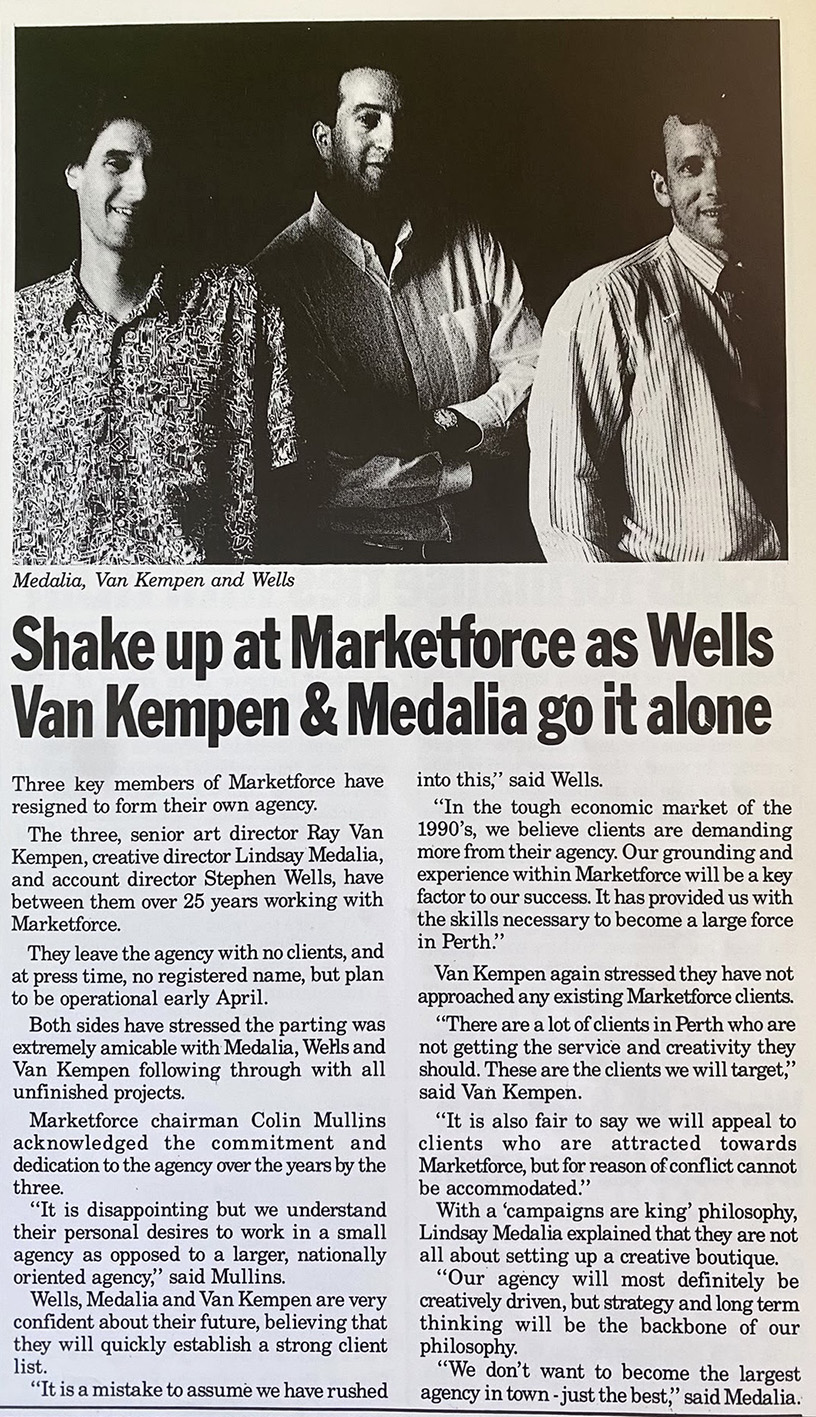
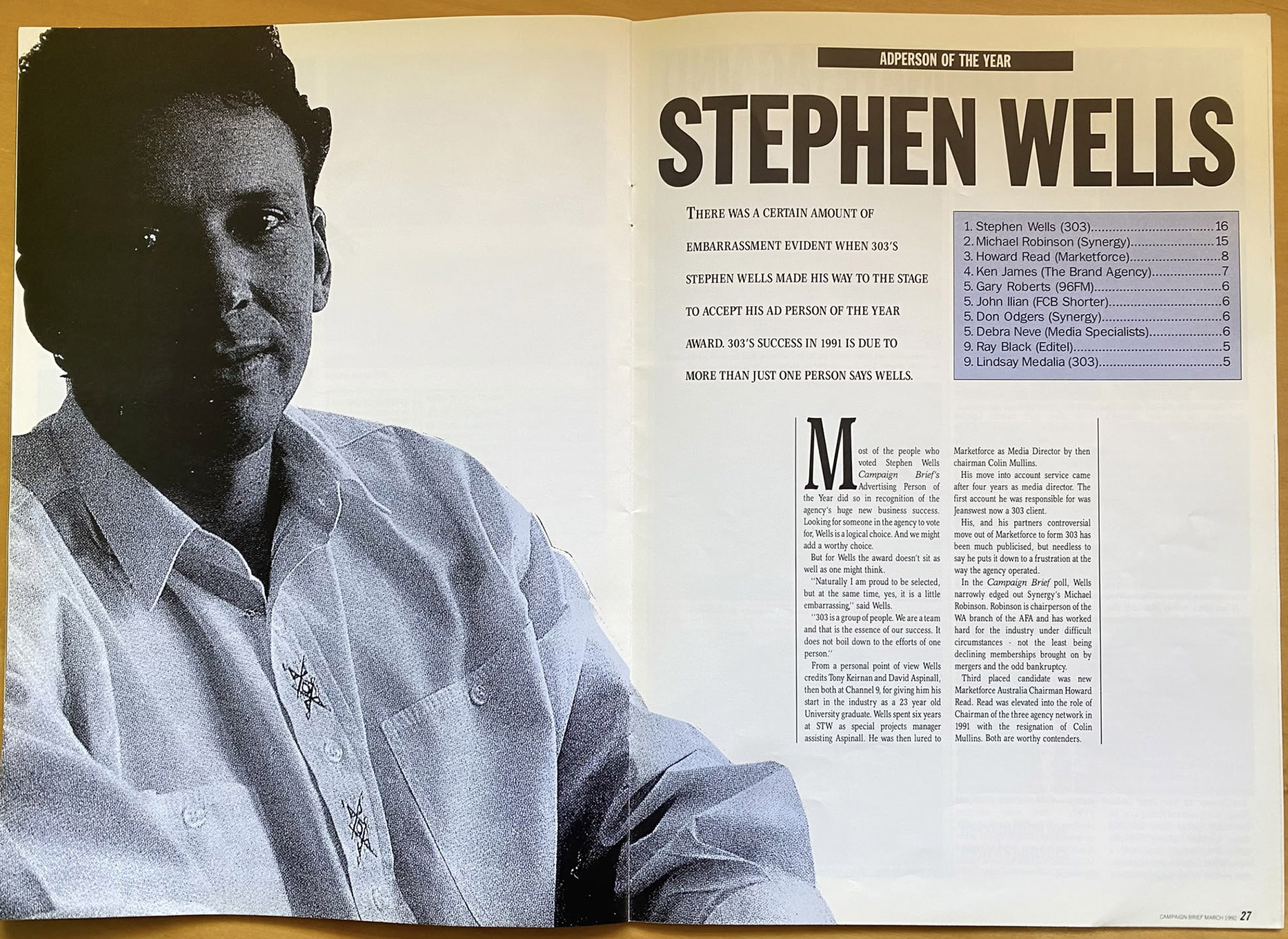
Colin eventually deduced that we were having too good a time at the Sebel and arranged a chartered light aircraft to fly us home. It took over three days. We arrived back in Perth having made the decision. The months that followed were careful, deliberate, and not entirely comfortable. We sold our shares. Ray Van Kempen joined us. We planned our exit. And then we announced it.
Everyone was gobsmacked. Colin and Howard were not happy, to say the least!
A farewell party was arranged at The Aberdeen Hotel. It was, by any measure, an extraordinary evening. Almost every Marketforce staff member present, the atmosphere electric, the atmosphere warm in the way that endings can be warm when everyone understands that what’s ending was genuinely good. Then, well into the night, the JeansWest team arrived at the pub. They’d been meeting with Colin, there had been offers, inducements, spurious arguments for loyalty. I told them what I believed: if you want to save money, stay at Marketforce. If you want to make money, have fun, and do things differently, come with us.
They came with us. Colin and Howard, the following morning, were probably rightly so, not in a party mood. We were marched out of the building with some ceremony. Legals were threatened. Rumours were distributed. It was, in every respect, exactly how these things go. Watch the Mad men episode and you’ll get it.
Lisa Maclean, (Joan) who had worked with me on accounts and bore the brunt of the aftermath with characteristic resilience, was also escorted out the door, she immediately joined 303 now operating out of Ray’s backyard, as our first employee. Ellen Marie Deslandes, the enigmatic jazz singer, then a finished artist now a designer and architect, but a person of extraordinary talent, became the second. Heather Smith and Ricki Smith followed. 303 was up and running… fast!
On culture
The point of all this is not merely the stories, though the stories are good. The point is what the stories reveal about what a business is and the pathway to success or decline.
Marketforce’s culture was a product of its time and place: Perth in the eighties, WA Inc, the America’s Cup, Bond and Connell and the rest of them. Hierarchical. Creative separated from clients. Account management as the interface between the two tribes. Male dominated. Margin extracted as a first principle. Lunch as the primary relationship tool. Long, expensive, occasionally legendary lunches. It was fun, and it worked, and it produced genuinely good advertising. But it was it built for a world that was changing?
303 was built on a different premise. Egalitarian. Creative-driven. The writer, art director and account manager working directly with the client with no buffer layer, no internal politics between the idea and the person who needed it. Outcome focused rather than process focused. Pay the best salaries to get the best people, then trust them. If you’ve finished your work, go and do something you enjoy. The desk and how long you sit at it is not the measure of the person. You charge the value of the idea/creative solution even if the idea is generated in 3 mins by the team of three. Pay your suppliers on time. Have fun. Do the right thing by your clients even when it costs you something.
These were not revolutionary principles. But, they felt like a genuinely different way of operating to what we left, and they turned out to be more durable than the model we left behind.
Marketforce went on to have a long and enduring place in the industry after we departed. Howard Read became Chairman and ran it with skill.
But the era we’d lived through, the era of Colin and Horny and the big West Australian brands and budgets that allowed Swan Black ferry and the balloon over the Serengeti, that era was slowly setting on the horizon. It didn’t last, because it couldn’t. You can’t manufacture that particular combination of talent, timing, hubris, and sheer bloody minded now probably inappropriate fun.
What Ray, Lindsay and I did was understand what made it work, strip out what didn’t feel right, and build something that would carry the spirit, not the ballast, forward into a different world. That’s what 303 was, at its best.
Stephen Wells was a director of Marketforce from 1985 to 1990. He co-founded 303 in 1990. He left 303 in 2001 to start travel technology business V3 which operates its Tourism Exchange platform in Australia, USA, Japan, UK and Saudi.
2 Comments
Oh the stories we could all tell! Thanks Stephen for reminding us all of the Marketforce that was not only a force to be reckoned with, but one that invested in developing young talent and made it possible for so many people to have terrific careers both in and outside and advertising industry. While there were some things I wish I could unlearn (the 80’s version of Mad Men certainly opened my very young eyes) I am forever grateful for having been part of both Marketforce and 303 (and both thanks to you Mr Wells!)
Son swallows father.