
Cost of living pressures shape summer holiday planning as online travel audiences rise – Ipsos iris August data
Australians are using the start of spring and the countdown to Christmas and school holidays as a cue to start planning their summer getaways, with travel-related websites and apps recording strong audience growth in August, Ipsos iris data released today reveals.
Visitors to travel-related website and apps increased 2% month-on-month in August, from 17.6 million to almost 18 million, reaching almost 85% of Australians aged 18 and over.
Both men and women were actively making travel plans in August, with the travel category reaching 88%, or 9.5 million Australian women, up from 9.3 million in July, and 80%, or 8.4 million men, up from 8.3 million last month.
On average, Australians spent 61.5 minutes per month browsing travel websites and apps.
Within the travel category, the tourism information-seeking audience grew by 6.5% month on month to just over 5 million, up from 4.8 million in July, while the cruise audience rose by 5.5% up from 2.2 million to 2.35 million. The airline audience also increased, up 4.7% in August from 9.1 million to 9.5 million.
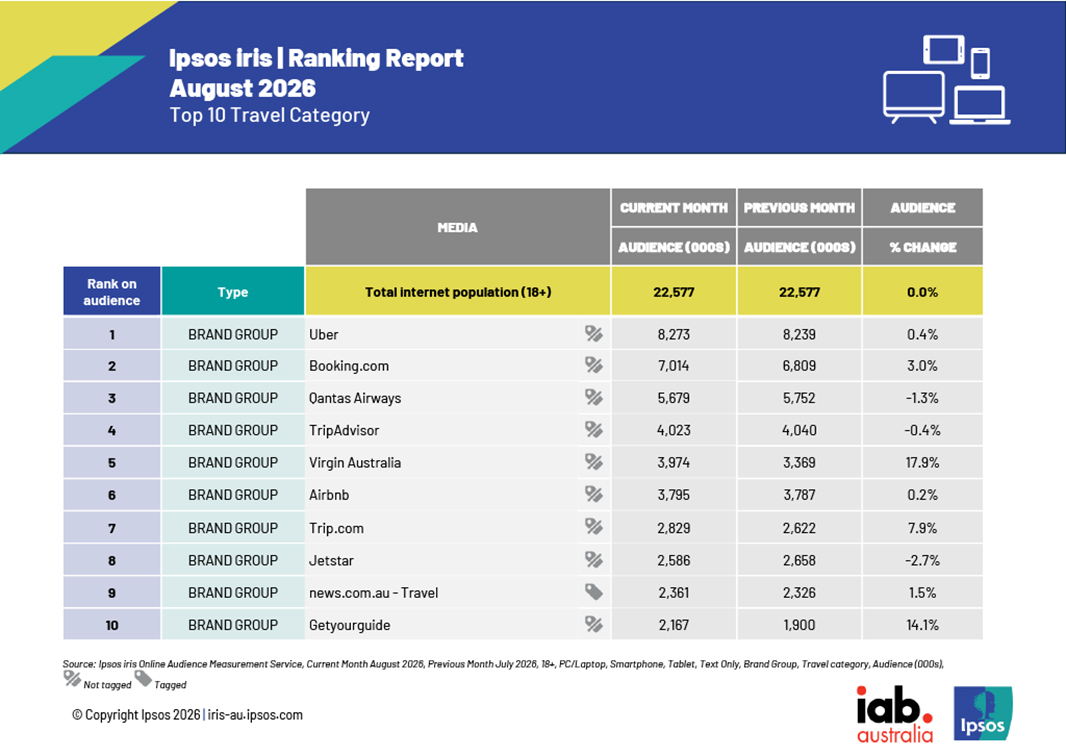
Holiday planning research was top-of-mind with many Australians, with the Booking.com website and app audience growing by 3% – a sizeable increase from 6.8 million to more than 7 million. Similarly, the Trip.com website and app audience also increased by almost 8% from 2.6 to 2.8 million.
Virgin Australia’s website and app audience also experienced significant growth in August, up 17.9%, most likely driven by its one-week international sale.
The chart above shows the Travel brands’ ranking during August 2026 by online audience size.
Dolly Parton’s death, celebrity entertainment, the Sydney Swans investigation and the Nepal flood disaster lead news consumption in August
According to the latest Ipsos iris data, almost 20 million people used a news website or app in August, reaching 93.9% of online Australians aged 18 and over. Users spent an average of 3.39 hours last month reading news online.
Domestically, the ongoing Sydney Swans investigation following the alleged incidents at a Melbourne hotel dominated headlines, including stories about player suspensions, AFL scrutiny, sponsorship impacts and club fall-out.
The disappearance and death of teenage bushwalker Lily Hooper in the NSW Southern Highlands was also a key news story, along with the fatal crash at Hamelin Pool, where a head-on collision on Western Australia’s North West Coastal Highway near Shark Bay resulted in the deaths of two people and injuries to a child and several others.
The Western Australian by-election and the shock victory of One Nation, and the 2026 Logies red carpet also generated audience interest.
Globally, the deaths of iconic country singer Dolly Parton and actress Hayden Panettiere were key news events in August, along with the announcement of Prince Harry and Meghan’s return to the UK. The Nepal flood disaster was one of the month’s biggest stories, including articles on the dozens of missing Australians and the nation’s humanitarian efforts, plus the European solar eclipse, and the Clacton by-election in the UK, including campaign controversies and investigations into Reform UK finances. The controversy surrounding former Cambridge professor Jason Arday also attracted significant audience interest, following allegations of plagiarism and scrutiny of his academic credentials, before extensive reporting following his death in August.
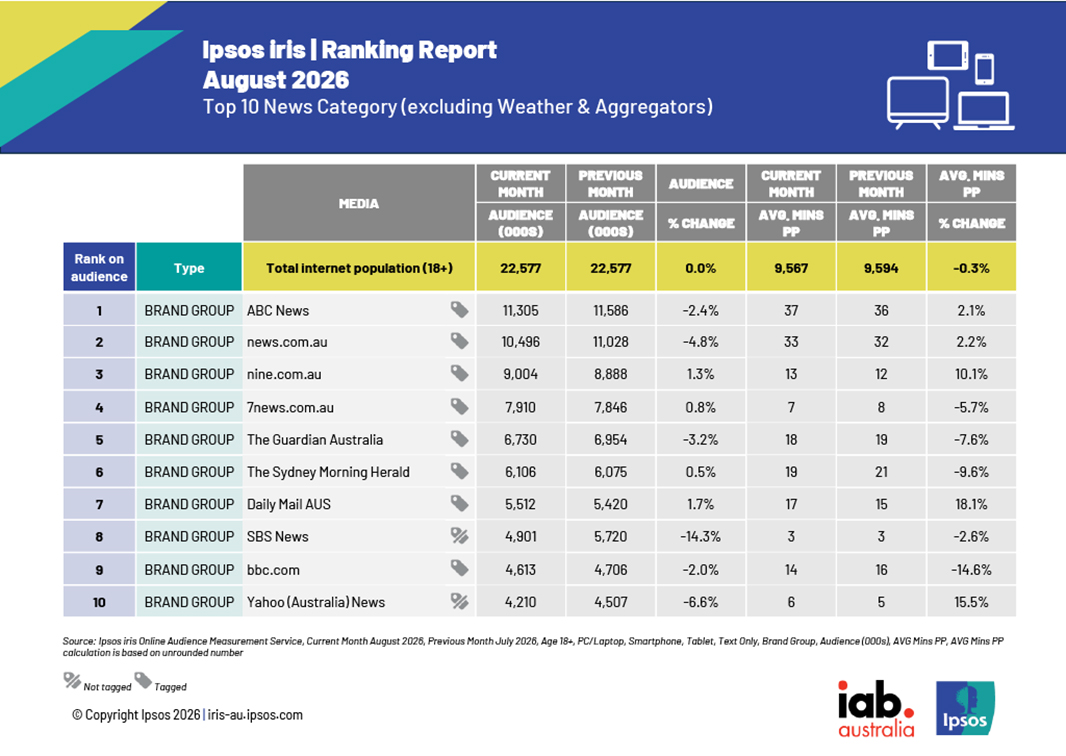
The chart below shows the News brands’ ranking during August 2026 by online audience size.
Social networking most consumed category last month, as more than 21 million Australians use the internet in August
Ipsos iris, Australia’s digital audience measurement currency endorsed by IAB Australia, showed that 21.272 million Australians aged over 18 used the internet in August, spending an average of 5.14 hours daily on average online.
The most consumed categories in August were social networking (21.13 million), online media (21.12 million), search engines (21.1 million), technology (21.05 million), and entertainment (20.8 million).
Ipsos iris provides accurate data about the 21.272 million Australians aged 18+ who access a wide variety of digital content and services across smartphone, PC/laptop and tablet devices.
Methodology change: From the July 2026 reporting period, Ipsos iris audience measurement is based on Australians aged 18 years and over, with 14–17-year-olds no longer included in reported digital audience figures. As a result, updated guidelines for the use of Ipsos iris data in market communications no longer permit comparisons between historical 14+ audience data (all reporting periods before July 2026) and the new 18+ audience data (July 2026 onwards). Comparisons across the trend break, including measures such as percentage growth or decline in website or app audiences, are not valid and should not be used.