Only 9 out of 100 agencies show AI integration, new audit from iStories finds
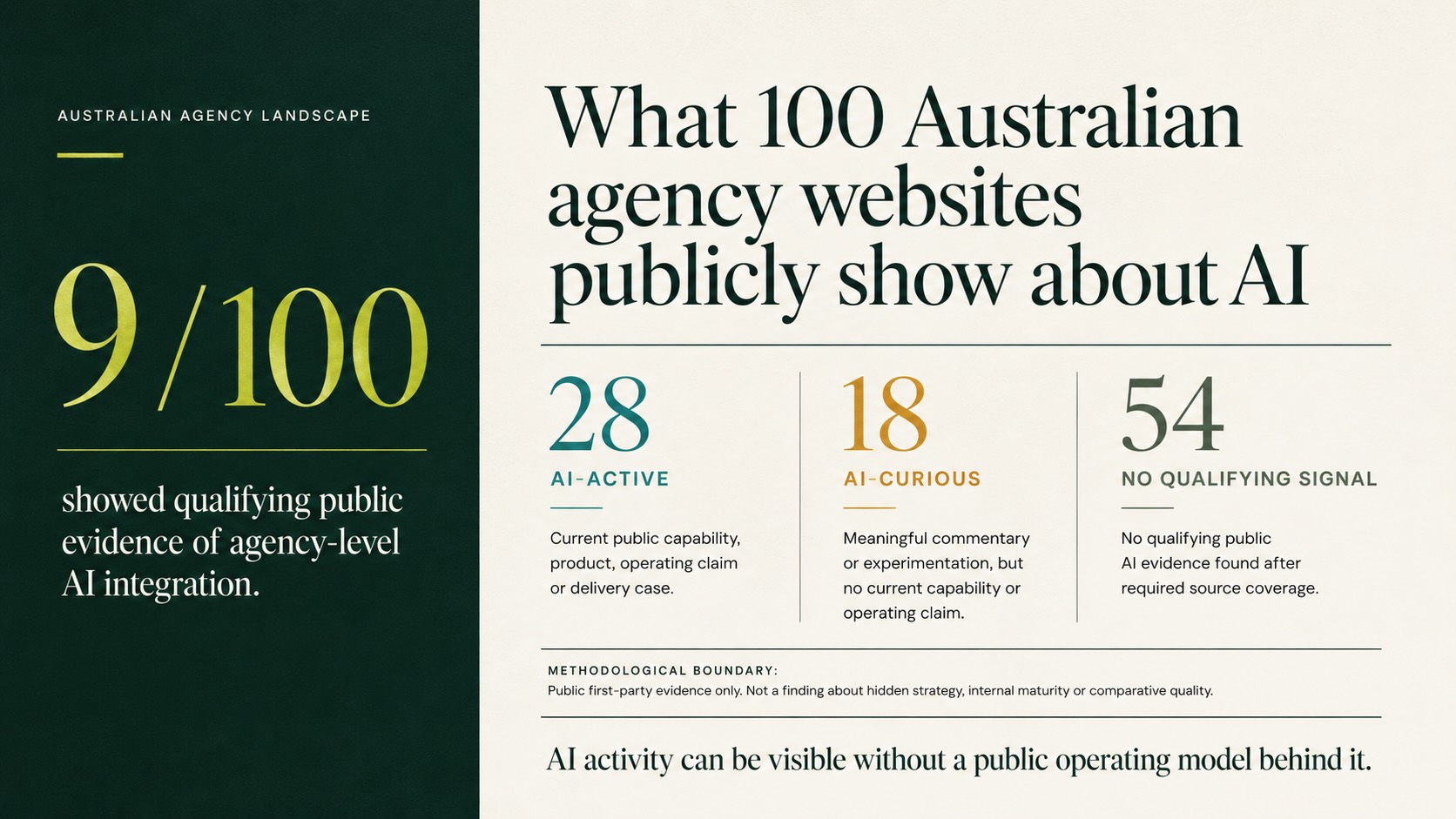
A new Australian agency audit from iStories has revealed a sharp gap between visible AI claims and public evidence of coordinated integration, while almost three quarters (72%) of agencies still make no reference to AI operational capabilities at all.
Among the 100 Australian agency websites reviewed in July 2026, only nine showed qualifying public evidence that AI formed part of how the agency operates through a repeatable workflow, named ownership, team enablement, governance or an integrated proprietary system.
As clients ask sharper questions about how work is produced, agencies unable to publicly explain their AI workflows, safeguards and accountability risk exacerbating a growing commercial trust gap.
Use is not the same as integration
Australian research has previously shown AI use is now near-universal, with 91% of 92 marketing businesses saying they currently used AI, and 87% rating it as important to day-to-day work, while a separate benchmark of senior Australian marketing leaders classified 52% of teams as “Beginner”, 40% as “Emerging” and just 8% as “Advanced”.
Such deep levels of AI adoption lead to the questions, why is public evidence of coordinated integration still so limited when reported AI use is already widespread, and why are so many agencies not vocal or visible in their use of AI at all?
Says Lee Robson, Director, iStories: “The finding is not that only nine agencies are integrating AI. A website audit cannot tell us that. The finding is that only nine of the 100 websites reviewed gave prospective clients public evidence of the workflows, ownership or safeguards behind their AI activity.
“An agency can use AI every day and still have no clear answer to which workflows matter, who owns the decisions, which tools are approved, where human judgment sits, or what is disclosed to clients. Those are genuine integration questions, and they are the ones the website audit found rarely answered in public.”
What the 100 website audit actually showed
The audit sorted every website into four public-evidence categories. The nine integration signals are a stricter subset of the 28 “AI-active” agencies. These agencies met the highest bar of not just showing AI capabilities, but same-context evidence of a coordinated, agency-level approach.
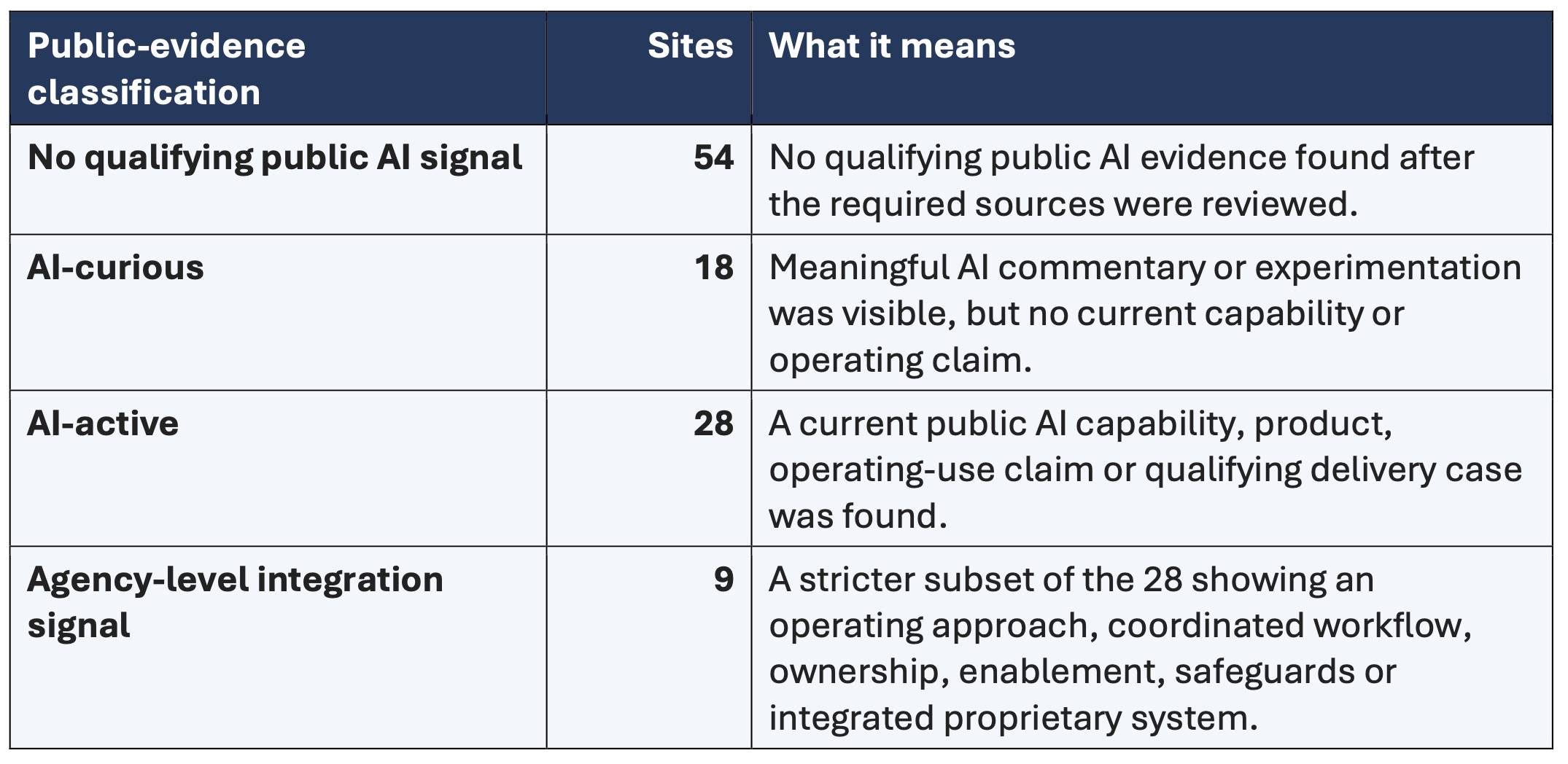
While it’s important to note that these categories measure public evidence, not private practice, just 28 of the 100 websites showed some meaningful public AI signal. Seventy-two of the 100 websites showed no qualifying public evidence of a current AI capability or operational activity, of which 54 showed no qualifying public AI signal at all, and 18 showed commentary or experimentation but no current capability or operating claim.
Says Robson: “Prospective clients can’t evaluate what they can’t see. Agencies may be doing genuinely good work behind closed doors, but among the websites we reviewed, the integration story was rarely demonstrated.”
What integration looked like when it did show up
The nine agencies that cleared the threshold were not ranked. Each simply published something concrete: an operationalised AI approach with a dedicated internal build team; an AI policy naming approved tools, requiring human review and mandating client disclosure; a proprietary in-house creative-testing system using synthetic personas and a calibrated methodology; a named senior AI leadership role; or an explicit split of which tasks run on AI agents and which decisions stay with senior humans. These are examples of what public proof can look like, not evidence that every other agency lacks equivalent practice internally.
Why the gap matters
A public claim of AI adoption should follow operating substance, and the diligence that goes into the judicious application of AI: choosing the workflows that matter, setting ownership, designing the human-plus-AI hand-offs, building safeguards, enabling teams, and being honest with clients about how AI changes the value of the work, not just the cost of producing it.

Says Robson (pictured above): “This snapshot points towards an unevenness and a persistent reticence not only about how to adopt AI, but how to integrate it in a manner that clients will increasingly be demanding insight into.
“Not every agency needs to make a bold claim about AI on its website, but there needs to be greater consistency across the sector when it comes to being clear about how teams are strategically integrating AI into their work.”
How the audit was conducted
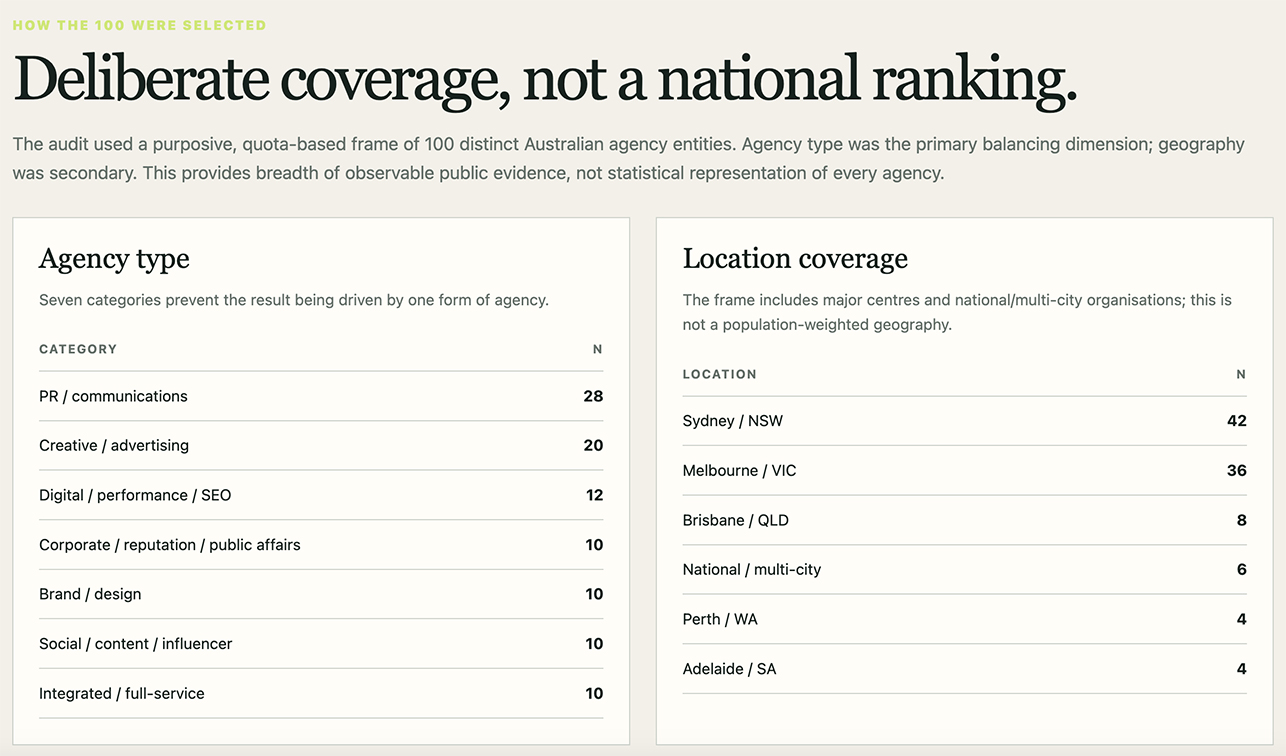
iStories reviewed public first-party material from a purposive, quota-based sample of 100 Australian agency websites. The frame was designed to provide coverage across seven agency types, including PR / communications, creative / advertising, digital / performance / SEO, corporate / reputation / public affairs, brand / design, social / content / influencer, and integrated / full-service, and multiple Australian locations, with agency type as the primary balancing dimension and geography as secondary. Candidates had to be active Australian agencies with a distinct entity and sufficient accessible first-party website material. Eligibility, accessibility and entity checks were completed before AI-related content was assessed. Every positive classification required a retained first-party URL and exact supporting excerpt; a “no qualifying signal” result required a locked coverage threshold. The audit reconciled 100 entities for redirects and duplicates, reviewed 931 first-party pages and documents, assessed 37 ambiguity items and ran 23 collection and adjudication regression tests before publication. The study is not a census, ranking or probability sample. Its findings describe the 100 entities audited and should not be interpreted as statistically representative estimates of the entire Australian agency market.
Full audit available at research.istories.io